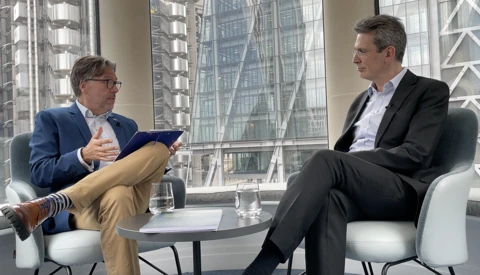


The panellists explored how mobility amongst High Net Worths, the increasing degree of digital innovation, and the demand for International Pension Plans are being powered by wider-ranging changes in work practices, driving international pension and savings plans for both employers and individuals.
Full Transcript
Guernsey Pensions Seminar 2026 ‘The Home of Global Mobility’ panel
Helen Dean CBE
Good afternoon, everyone, and welcome to our combined pensions panel. I think one of the most interesting things about today's discussion is that we've brought together experts from very different parts of the pensions ecosystem, and that should give us a really rounded perspective on the opportunities and challenges represented by an increasingly global mobile workforce.
So, joining us today, we've got, first of all, Stephen Ainsworth, who is Senior Partner at BWCI Group. Stephen is one of Guernsey's leading pension professionals. He's got decades of experience advising international pension arrangements and multinational organisations.
We've also got Neil Byrne, Director at TFO Tax. Neil specialises in personal taxation and pension planning. He advises high-net-worth individuals, entrepreneurs, sportspeople, all sorts of people, and has extensive experience.
We've also got Rachel Sanders, Associate Director at Concept. Rachel brings quite a unique combination of legal, accounting, fiduciary, and pensions expertise together with extensive experience of helping clients navigate international financial structures.
And last, but not least, we've got Alessandra Santiago, who's Head of Pensions and International Benefits at Inchcape. Alessandra oversees pensions benefits for a workforce of more than 16,000 employees across 40 countries. So really great first-hand experience and insight into what global employers need from modern pension arrangements.
Really looking forward to hearing their perspectives as we explore why global mobility is reshaping the pensions landscape.
So, welcome to our panel, and I'm going to start with my first question for Stephen. So, Stephen, coming to you first: how has the impact of globalisation changed the world of corporate pensions?
Stephen Ainsworth
Thank you, Helen. Well, as you say, I've been around a little while, and globalisation itself is not a new phenomenon. Guernsey has been an international finance centre and a centre of excellence for international pensions for nearly 50 years. I'm not claiming to be around for the whole of that, but I'vebeen around for a fair bit of that time.
But Guernsey is quite unusual as a location in that its pension scheme membership well exceeds its domestic population. It's an indication that we've got pension providers here serving the global needs of our multinational clients. Originally, it tended to be the international banks and the international trading groups, such as oil companies, who needed to provide pension solutions for their expatriates and their third country nationals, typically because they could not remain in the UK pension schemes - that was the rule at the time. But over the years international pension needs have changed. They'vechanged from traditional defined benefits arrangements to defined contribution schemes, and from expatriate arrangements to global arrangements providing pensions to locally based employees all around the world, particularly in locations where there are no reliable sources of local pension provision.
That's the history, but more recently we've been seeing newer companies expanding their operations outside their home territories. They need competitive pension packages to attract and retain the staff they need, and to support their expanding international operations. And of course, that now includes those who are recruiting global nomads who can work remotely overseas, even when the firm's operations remain fairly domestic. So, all in all, we have seen quite a change as globalisation has progressed.
Helen Dean CBE
Thank you, Stephen. Yes, that does sound like quite a change, and I guess my next question then is for Rachel. Building on that, Rachel, what's changed for the personal pension landscape in this much more global world that we're now all trying to manage in?
Rachel Sanders
Exactly. So as our members have become more global, they have really - they want things done quickly, so they have 24-hour access to their portfolios. If they want to change investments, they wanted it done pretty much immediately.
Another change that we've got is that Guernsey has implemented the landscape to have member-directed pensions. So if a member wants to be appointed as investment manager over the assets in their pension, then that is something that we can certainly do, subject to the tax residence of the member allowing that, and if the tax member isn't able to do that, then they can be appointed as investment advisor over their pension assets, so that gives members a lot more flexibility, they can do a lot more of what they want to invest in what they want to do, and a lot quicker than ever before.
Helen Dean CBE
So, a lot of choices there for the employer.
So, I guess maybe good to hear from Alessandra, because we've heard that globalisation has had a big impact on the pensions industry. We've heard that that's happened in a number of ways in the corporate and the personal pensions industry. I guess in this more global world, Alessandra, what are employers looking for when they're actually evaluating pension products?
Alessandra Santiago
That's a great question. We have faced a number of challenges in terms of global mobility, because in this new world we need people to move quicker from one side to another, so we can have the people with the right skills in the right places, and one of the main challenges we face when moving people abroad is actually pensions, because it's very difficult to provide continuation to people in their pensions, and you know many times we are mandated to actually offer pensions products either in the host or the home country, so there are some challenges on this.
So, anything that can provide us with flexibility to help people move abroad and have this continuity in their pensions is very helpful, but something else that global globalisation has provided in or changed in the pensions landscape is definitely about investments. So, I think both participants and companies are willing to - for investments to happen abroad, so if we look backward many years, we would have a very strong local bias. So, for example, in the UK, people would invest a lot in pensions, in UK bonds, in UK equities, and now there's an expectation that you'll be able to invest globally in the best products available globally. So, I think that those are some important aspects to highlight.
Helen Dean CBE
Great, thank you very much, Alessandra. And, of course, Neil, it's not just multinationals that people are building careers with. As we heard earlier, we've got digital nomads, we've got sportspeople, all sorts of people can see their career taking them in all sorts of really interesting directions, and what is it you think that Guernsey offers to those individuals who are building their careers overseas and often relocating, perhaps never even to return to the UK?
Neil Byrne
Yeah, it's certainly been an interesting journey, I would say, over the past 15 to 20 years, with, you know, like you said, globalisation and people moving from jurisdiction to jurisdiction, whether that's because that's where the job's taking them, that's whether you know, like you say, sportspeople, people in the entertainment industry, and more often these days people, you know, a lot of people are moving into different jurisdictions to try and find a tax efficient location. You know, we're seeing that more and more, and what we've seen from our experience, what we've seen is that I would describe Guernsey, as a very friendly jurisdiction, as far as pensions are concerned, because the legislation is very, I would say, mature, it's well established, it's been around a long time, and our experience is that it interacts well with other jurisdictions and their rules and regulations. I mean, one example that I can give, especially for individuals, not necessarily corporates, but for individuals, is there are certain jurisdictions that don't like trusts, so if you've got a trust-based pension scheme, which most pension schemes are, then it can, with certain jurisdictions, it might not interact that well, but with Guernsey, as an example, you've got the ability to have contract-based pension schemes, which it removes that problem completely. So, our experience is that no matter what the individual is involved in, whether they're an entrepreneur, sportsperson, entertainer, having a pension in Guernsey, it's very portable, and they can take it from jurisdiction to jurisdiction, wherever they go, that's our experience anyway.
Helen Dean CBE
Neil, I think you’ve just come up with a strap line for Guernsey Finance: “Guernsey, the jurisdiction that's friendly to pensions”. That's really great.
So, Rachel, you are Guernsey based, and so maybe you can shed some light on how friendly jurisdictions like Guernsey, what you're doing to keep pace with all of these developments.
Rachel Sanders
Yes, so globalisation brings lots of challenges with it. One of them is the fast pace of change, so as Alessandra has already mentioned, people want things done quicker, so for example, sometimes we get people coming to us going: “I want to invest in SpaceX IPO”, for example, and they want their money straight away to do that. So, as pension providers, we need to invest in the systems to allow that. So, we actually at Belasko have an AI company, which is creating AI solutions to streamline our processes.
Alessandra has also mentioned global asset classes that people want to invest in these days. So, you've got your plain vanilla pension assets, such as investment portfolios and investment bonds, but increasingly we're seeing people going into alternative asset classes. So, that's things like real estate, including commercial and residential, we’ve got precious metals, we've got private equity, and there's also things like passion assets, so fine art, wine, luxury vehicles, that sort of thing. And another aspect of globalisation is tax transparency, and Guernsey has been an early adopter of FATCA and CRS, because that's what our members expect.
Helen Dean CBE
That's a very broad offering from Guernsey. Impressive.
So, Stephen, back to you with globalisation, there is the natural outcome that firms are perhaps starting to operate in markets that they've never worked in before. How important do you think it is for those firms to have solutions that are based in a leading centre for pensions to support their staff, both from abroad and for those who are local in these new markets, as they start to develop them?
Stephen Ainsworth
I think you're right, Helen. This is a key demand. Very often we find these firms only have a handful of staff overseas, but they still require a competitive pension solution, but both have comparability with their home-based workers, but also to attract the best staff as they expand overseas. So, what they'relooking for, and what the Guernsey pension providers can provide is a tried and tested pension solution offered by experienced pension professionals in a secure and a well-regulated environment.
I think that's what attracts people to Guernsey pensions. We are finding that to some having off-the-shelf products has become increasingly important. It's exactly what Rachel was saying. People want pensions and they want it now. There can often be time pressures to deliver a competitive solution rather than what traditionally we would have done, which is design a highly bespoke solution over a period of months. Now they want a solution within a matter of days, and this is what Guernsey pension products can provide.
Equally, they do require instant web access. There's very much a demand for that. Online member access and online employer access is really important, not only for speed of communication, but because there are sort of time zone differences, there can be language differences, such that a well-designed website with the appropriate language facility enables instant communication, so that as people would with their bank account, that they will know exactly what their pension assets are, and for what to make changes, they can do so online by the press of a button. Over the last few years, that'sbecome an increasingly important part of our offering.
Helen Dean CBE
That’s really interesting, so you've got quite a multifaceted offering, you've got the breadth of the offering that Guernsey can give you, the strength of the regulatory environment, the speed to market, as we were hearing it earlier, embracing new technology and AI, and all of those things sound like they're really, really important.
Alessandra - 16,000 employees over 40 countries. I guess for you continuity must be hugely important for you from a management perspective, but not just from that perspective, but for the employees themselves.
Alessandra Santiago
Yes, definitely, Helen. So, this is one of the challenges we face, is consistency and continuity, because being present in 40 countries means that we need to offer different benefits in different markets, but at the same time we wanted to come up with a framework that made the benefits consistent somehow, trying to provide a similar employee experience. So, we developed a simple framework where basically we agree that all benefits for each of the markets need to be market competitive compared to the local market, and need to meet global minimum standards.
At the moment, we have as global minimum standards life insurance, employee support programme, and parental leave, so minimum levels for all of them, no matter where the person is located. And something we are considering at the moment is including pensions as one of our global minimumstandards. Now, one of the challenges we face is obviously the different markets have different parameters, let's say, so we definitely need to come up with a solution that is consistent and provides continuity for employees, and Guernsey seems to be a great starting point for us to consider this, so it's, it's definitely something important. Because I was, as I was mentioning before, that's a big challenge I have. For example, we move someone from the UK to Chile, and then somewhere else, let's say Poland, and that that person comes to me and says: “I don't know what to do with my pensions in Chile, because it's stuck there. I don't know how to move it. How I'll have access to it”. It's a very complicated topic. So, for us, definitely a solution that can provide consistency and continuity as people move from one place to another would be something amazing for us.
Helen Dean CBE
It's such an eye opener, Alessandra, to hear you talking about the logistics of trying to manage across 40 countries. It's just mind-boggling. Absolutely, absolutely incredible. I don't envy you that task, but I think it's great that companies like yours are taking it so seriously.
Neil, I'm sure that something the audience would be interested in is the state of QNUPs and, more broadly, some of the changes to IHT. What do you see as the future here, and how might this affect the IPP market?
Neil Byrne
Yeah, so going back to the late 2000s, QNUPS were very attractive because they gave people the ability to build up pensions in a very IHT-friendly manner, and Rachel touched on it before, that QNUPS can hold assets such as residential property, which you can't hold in a UK pension, and that's attractive for a lot of people in the UK, because a lot of clients are property-based, they have property investments, they see those as a more, in their view, a more solid investment than stocks and shares, for example. So, the ability to hold those in a pension scheme that was IHT friendly was really attractive, and then we had the announcement by the government in the 2024 budget that from April 2027, pensions, including QNUPS, were going to be subject to inheritance tax, and that threw things up in the air, you know, for a time, because people weren't sure then how efficient QNUPS were going to be, and I must admit at that point we were thinking, you know, is there going to be a future QNUPS?
But then just before - so there was a last-minute amendment to the finance bill in March of this year, and what that clarified was that if you've got an individual who isn't a long-term resident of the UK, so someone who hasn't been in the UK for 10 out of the last 20 years, a QNUPS will be deemed to be an offshore asset, because for IHT from next year the pension itself is classed as a non-cal asset, and they clarified in legislation that someone who isn't long-term resident, a QNUPS is outside of IHT, effectively, irrespective of what the QNUPS holds.
So, for a lot of expats - for me, that brings QNUPS right to the top again in terms of tax efficiency for expats, because it gives people the ability to build a pension scheme - because at the end of the day this has got to be seen as a pension, it's got to be done properly, you've got to be able to justify the levels of the contributions - but for a lot of expats who have got assets in the UK, QNUPS now become very, very attractive again because, subject to being able to justify the contributions, this now gives them a vehicle again that they can effectively hold property investments, whatever the assets are, and they won't be subject to IHT on death. And that's completely – so, from how we felt in November ‘24 when the announcement was made that QNUPS were going to be subject to IHT to this new legislation confirming that for expats they're not going to be subject to IHT necessarily, it brings them right into the fore again. I think this is a really big opportunity, for Guernsey as a jurisdiction for the expat market, and again it goes back to that point about Guernsey pensions being portable across many, many jurisdictions, I think it's a big opportunity.
Helen Dean CBE
That's quite a transformational change. Yeah, absolutely.
So, Stephen, we've talked about keeping pace and how Guernsey's keeping pace. We've touched a little bit on the areas I think where Guernsey is leading the industry. Talk to me a little bit from your perspective about what are the areas where you think Guernsey are really leading the industry.
Stephen Ainsworth
Well, Helen, I think I'd probably sort of bring out sort of three particular areas. The first is that Guernsey's introduced pensions regulation, both for pension providers and for pension plans, but because the Guernsey Association of Pension Providers (GAPP) was working closely with the regulator in the design of this, we've got a pragmatic and flexible basis of regulation, so we can provide the appropriate security and comforts to pension members without needing to impose undue regulatory costs, which is also important. Regulation has got to be there, but it's also got to be sort of cost-effective. So, I think we've achieved that over the last few years, and that's been a real boost of confidence to people selecting a location and a provider for their pension assets.
Secondly, for many years we've had a very flexible tax approval regime, and that's been extended over the years, not just covering traditional international pension plans, but also for more recently designed international savings plans, which are effectively to gratuity schemes, but can be applied in a much broader way to provide pensions on leaving service as well as on ultimate retirements for those locations where that's a more appropriate form of structure to have. So, again that has developed and has kept us providing the solutions which our clients have been asking for.
And we're continuing to work on this as we talk to our clients, we can see where there are potential frictions between what the client would like to do and what they're allowed to do under our tax rules, and so we're actively in discussion to introduce additional flexibilities, particularly at the moment in relation to being more flexible in how we can distribute death benefits. If a member dies, we can always pay out a lump sum, but that may not be in the best interests for recipients. If that leads to a significant tax charge, they may prefer it deferred or to have it provided as income rather than capital. There are a number of flexibilities, which we're in the process of introducing in conjunction with the income tax offers.
And then I think the third area where we've seen development over the last few years is development of master trusts. This comes back to the speed of delivery points all over again, that rather than creating a new pension trust each time a client wishes to have a pension solution, you can offer an off-the-shelf master trust, it's there, they can sign up, and they can be ready to go in a matter of days, so I think that's another way that we're meeting the demands, certainly from our multinational corporate clients, which they've been asking for speed of delivery.
Helen Dean CBE
Great, thank you very much, Stephen. And Rachel, similar question to you: how does Guernsey stand out in terms of leadership in personal pensions?
Rachel Sanders
Yes, well, I'd say all the points that Stephen just said equally apply to personal pensions. In addition, Guernsey is a centre of excellence for residents and non-residents alike in relation to personal pensions. So, we've got a wealth of experience on island with tax advisors, accountants, lawyers, etc. We are super flexible, so as I've already spoken about the asset types that can be held and the asset management with member-directed pensions, those are already in place. We can loan funds to members, so if you've accumulated a pot of contributions over your lifetime, you can come to us and say, "Please, can I have a loan?” - we had someone the other day, we had a chef wanting to set up his own restaurant, so we could lend him the money to do that. So, pensions really are relevant through all life stages, not just when you retire.
We've spoken about structuring as well. So, there's so many different pension structures that are available to people in Guernsey, so we've got the off-the-shelf multi-member pensions available, or you can have a more bespoke arrangement that's tailored to you. We've got, as Neil said, trust-based pensions or contract-based pensions. We've got regulated pensions, and for those who want something a bit more flexible, we have unregulated pensions available as well. For employers, you can have your traditional occupational scheme, or you can actually have a personal pension scheme for your employees that's tailored for that one employer, all in the same scheme, and you can consolidate all your pensions, so you can take pensions from around the world, transfer them to Guernsey, put them all in one place, so it's nice and easy to manage, so there really is a solution for everyone.
And the final thing I'd say on the personal pension side is that Guernsey is a tax-neutral jurisdiction, which means that all your investments can accumulate in your pension, all the gains, they're not taxed. There's no Guernsey income tax, unless you're actually a Guernsey resident when you withdraw your money, and Guernsey doesn't charge any kind of inheritance taxes or capital gains taxes. So, it's a lovely, stable, secure, tax-neutral jurisdiction.
Helen Dean CBE
I think, between Stephen and Rachel, that gives a really strong indication of the benefits that Guernsey can offer.
Alessandra, thinking forwards a little bit, as globalisation really starts to have a bigger impact, and new technologies start to emerge and a whole range of other factors start to make a real impact on the workplace, how do you think that pensions themselves need to adapt to accommodate the next generation of beneficiaries?
Alessandra Santiago
Yeah, I think this new generation is demanding new things, right, from pensions, so we need to forget the old forms, and you know, the traditional bureaucracy with pensions, and we just need to evolve into a more friendly technology. Obviously, the use of AI is something extremely important that needs to be taken account for. The other thing is responsible investment, that's something important for the new generation as well. They look more on where they are investing, you know, they challenge us more on this.
And definitely I think more flexibility, as we discussed throughout, it’s important because people will likely move. It seems that the world is speeding up somehow, and things are moving faster. So, I think the younger generation will be likely to move more jobs than the older ones did, and for this reason,it's all the portability, flexibility.
Another thing that Rachel mentioned about stages of life, even in terms of contributions, right? There are some times in your life where you can afford to contribute more, while there are other stages in life where you can't contribute that much, and having that flexibility is really important as well.
But one aspect I'd like to highlight is the longevity risk, because for me this is something that the pensions really need to evolve somehow, because we move from defined benefit, where mainly the longevity risk was with the employer, to defined contribution, where it's now with the individual. Now managing longevity risk on your own as an individual is something really difficult. I work, actually, as in wealth management with multifamily office, so looking after wealthy families for a number of years, and we used to do all the calculations for them, but they were so wealthy that we could have assumptions. They wanted to leave inheritance for family, and so on, so you could manage it in a way that they wouldn't suffer from longevity. But if you look at an individual that wants to use their money throughout their lives, that's a big risk. You can't assume, "Oh, I'm going to live till 100. What happens if I live to 110”, but at the same time, if I save too much and not spend much, I won't be able to have the standard of living, and somehow we need to come up with a better solution for this.
So, I think the new generations will really need that, because they're definitely not expected to save as much as the previous generation saved either themselves or the employers, and therefore we need to somehow come up with a better solution for this.
Helen Dean CBE
I couldn't agree with you more. It just, and it feels like every jurisdiction is grappling with this, even really mature jurisdictions like Australia still grappling with this. It's such an important area that I think globally we, you know, we need to get our heads together and think about.
Neil, I guess one of the things that maybe this leads us to think about is the importance of education and making sure that people really understand their pensions, perhaps better than they have previously, and are better equipped to manage them. So, how do you see the role of education in pensions, and particularly for younger clients? How important is it that we educate them on what a pension is and what it can be for them?
Neil Byrne
Yeah, I think it's vital. I think - but what we've seen more recently is that that is happening to an extent, because we are seeing a lot more younger clients who are asking questions about pensions, and you know, quite a few are surprising me, because going back a few years, all the discussions we would have about setting up pensions in other jurisdictions would always be with probably many people in the 40s and 50s, whereas those discussions now were taking place with people in their 20s and their 30s. And again, where I think a location like Guernsey, this is attractive, is if you look at the UK, for example, you've got a lot of young people working in the City earning very good money, but in the UK, the more you earn, the less you can put into a pension scheme, so they need to look at alternatives, and that's where we're getting a lot of questions from younger clients, you know, “I can only put this much money in my pension, but I want to put more”.
It might be that, especially if they're a non-domiciled individual, they may have been an international student who's now working in the City, they're looking - they might not have plans to stay in the UK, so they're looking at alternative pension schemes and jurisdictions like Guernsey, and it goes back to the point that we mentioned before about having a Guernsey pension and being able to take it with you wherever you work. So, I think the education side of it is vital, but we're certainly seeing that already happening and taking place because of the questions that we're getting from younger clients
Helen Dean CBE
Absolutely, and I guess you know we've had a good canter round today in this discussion on globalisation, new technology, changing customer expectations, changing workplace, and what that means for employers. I think maybe the last word to Rachel - so, Guernsey is regarded as a reliable and expert partner for many. Maybe you could just summarise for us and tell us what it is you think it is about Guernsey that sets it apart from other jurisdictions.
Rachel Sanders
Absolutely. So I think there's four main factors. So, first of all, the depth of experience here. So, as Stephen alluded to earlier, Guernsey has more pension plans than it does people. So, Guernsey is a small island, there's 64,000 people here. We realised early on that the domestic market wasn't going to be that big for us, and so we've diversified, like 50 years ago, into international pensions, and we've got a lot of expertise in that area. We target, we have products that target individuals in certain markets, so there are a lot of pensions aimed at UK or US or South African residents, for example.
We've spoken about the integrated ecosystem of providers, so you've got your tax experts, lawyers, investment managers, everybody here, and they have cross-border expertise, so everybody is used to helping non-residents with their pension requirements.
Third, the regulatory environment, so Stephen has already spoken about how we have very pragmatic regulation there. I would say that all financial services providers in Guernsey are required to be regulated by the (Guernsey) Financial Services Commission, so there's no exemptions for small businesses, so members have that security and peace of mind that their provider knows what they're doing and they are appropriately regulated.
And then the final factor is that we have really strong relationships between industry and government, so the States of Guernsey has recently commissioned a report into the financial sectors industries - so that's across insurance and fiduciary, pensions, banking, investment - and they are looking at innovative ways to enhance Guernsey's private wealth super hub status, so there's a lot there that's really good for Guernsey
Helen Dean CBE
Brilliant, beautifully summarised. Thank you very much, Rachel. And I'd just like to end by saying a huge thank you to Steve and Neil, Rachel, and Alessandra for an absolutely fascinating tour de force around the pension system as it is now, and as it's going to be in the future, as it's changed by globalisation and by a changing workforce, and I'm definitely left with the strap line “Guernsey: the pensions-friendly jurisdiction”. Thanks very much, everybody.